
STP Plant Cost in India: Factors, Technology and Installation Guide
October 14, 2026
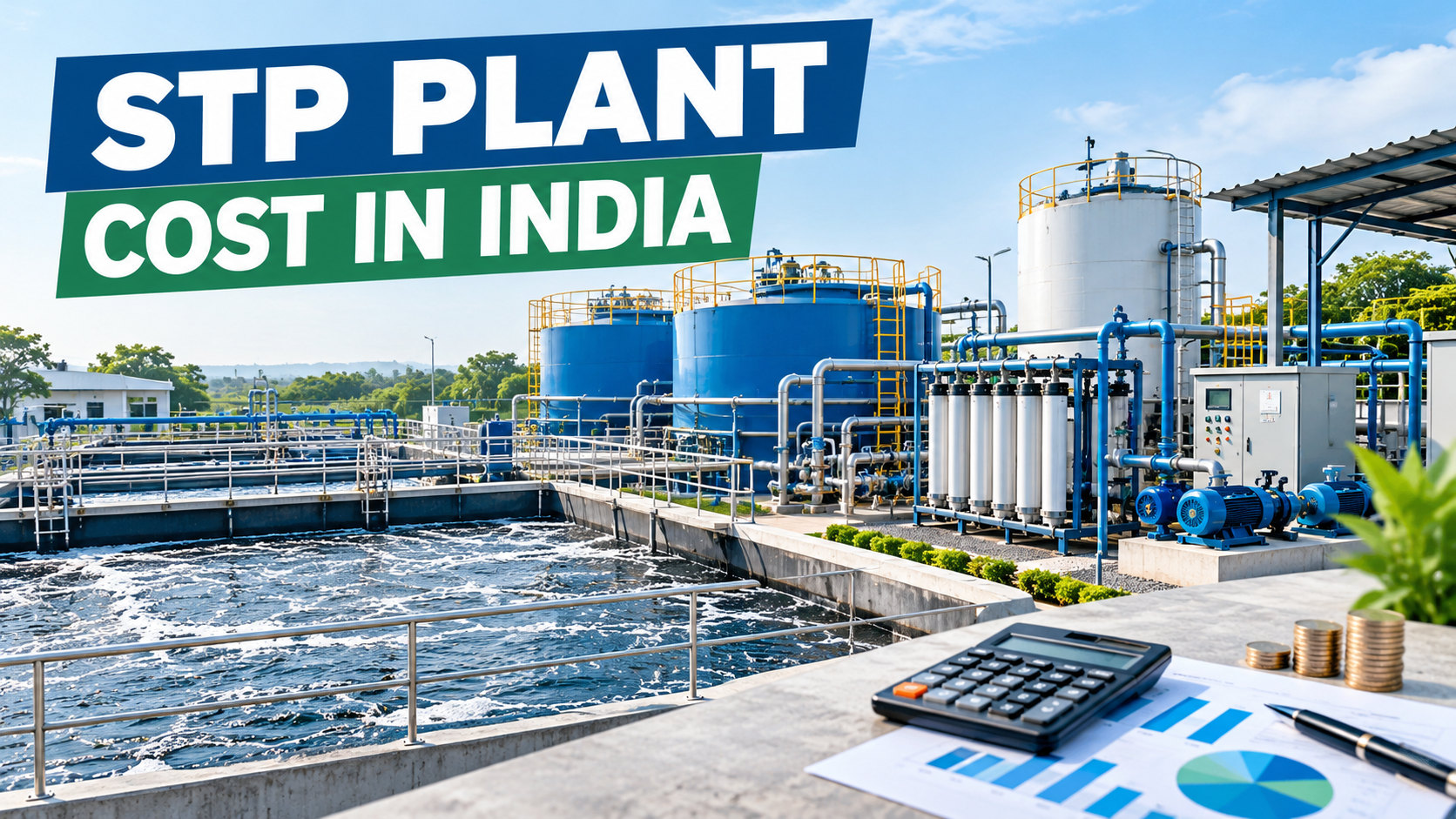
Planning a sewage treatment plant requires more than selecting equipment and arranging installation. Residential societies, hotels, hospitals, commercial buildings, and industrial facilities must consider wastewater generation, treatment technology, available space, and long-term operating requirements before estimating their investment.
The STP plant cost in India varies from project to project because every facility has different sewage treatment requirements. A compact system for a small building will have different specifications from a large-capacity plant designed for a residential township or commercial complex.
Understanding the factors that influence the sewage treatment plant cost helps project owners plan their budgets, compare quotations, and select a suitable system for long-term operation.
What Determines STP Plant Cost in India?
There is no single price applicable to every sewage treatment plant. The total investment depends on the plant’s design, equipment, treatment process, installation scope, and site conditions.
Before requesting a quotation, it is important to understand the main cost components and how they affect the overall project budget.
1. STP Plant Capacity and Daily Sewage Generation
Plant capacity is one of the most important factors affecting the STP plant price in India. Capacity is generally measured in KLD, meaning kilolitres per day. One KLD represents 1,000 litres of wastewater per day.
A small residential building may require a compact treatment system, whereas a hotel, hospital, or large housing society may need a higher-capacity plant.
Capacity selection should consider the number of occupants, daily water consumption, sewage generation, peak flow, and potential future expansion. An undersized plant may struggle during high-flow periods, while an unnecessarily oversized system can increase capital and operating expenses.
Accurate capacity assessment helps establish a practical budget and supports consistent treatment performance.
2. Treatment Technology and Plant Design
The selected treatment technology influences equipment requirements, installation space, energy consumption, and maintenance needs. Different technologies offer different advantages depending on the application.
MBBR Sewage Treatment Plant: Moving Bed Biofilm Reactor technology uses specialised media to support biological treatment. It can be suitable for residential, commercial, and other projects where compact design and operational flexibility are important.
SBR Sewage Treatment Plant: Sequential Batch Reactor technology treats wastewater in controlled cycles. It can be considered for projects requiring automated process control and effective biological treatment.
MBR Sewage Treatment Plant: Membrane Bioreactor technology combines biological treatment with membrane filtration. It is often considered where a compact footprint and higher treated-water quality are important.
The appropriate technology should be selected according to wastewater characteristics, treatment objectives, available space, and operating requirements rather than initial price alone.
3. Civil Construction and Installation Requirements
Civil work can significantly influence the overall STP plant installation cost. Projects requiring underground tanks, concrete foundations, additional structures, or substantial site preparation may involve different expenses from packaged systems installed on prepared surfaces.
Installation-related work may include equipment placement, piping, electrical connections, control panel integration, foundation preparation, testing, and commissioning.
Site accessibility, transportation, soil conditions, and existing infrastructure can also affect project requirements. Therefore, quotations should clearly specify whether civil construction and installation are included.
4. Equipment Quality and Automation
The quality and specifications of equipment also affect the sewage treatment plant price. Pumps, blowers, aeration systems, filtration equipment, tanks, valves, and electrical components must be selected according to the plant’s operating conditions.
Automation requirements can influence the initial investment as well. Basic control panels may be sufficient for some projects, while larger facilities may require programmable controllers, automated dosing, alarms, and advanced monitoring.
Suitable automation can simplify operation and improve process control, but the system should match the facility’s actual requirements.
5. Wastewater Characteristics and Treatment Standards
Not all sewage has the same composition. Wastewater from residential buildings can differ from wastewater generated by hotels, hospitals, commercial kitchens, and other specialised facilities.
The required treated-water quality also affects plant design. Systems intended to support water reuse may require additional filtration, disinfection, or other treatment stages.
These requirements influence equipment selection, process complexity, and the overall STP plant cost in India. The treatment design should therefore reflect the wastewater characteristics and applicable discharge or reuse standards.
6. STP Operating and Maintenance Cost
The initial purchase price represents only part of the investment. The STP plant operating cost includes recurring expenses associated with electricity, routine servicing, consumables, sludge handling, and replacement of worn components.
Energy-efficient pumps and blowers, suitable process design, and regular preventive maintenance can help manage operating expenses. Neglecting maintenance may lead to equipment failures, inconsistent treatment, and additional repair costs.
When comparing different systems, evaluate both the initial capital expenditure and the expected long-term cost of ownership.
7. How to Estimate the Total STP Project Cost
A practical STP cost estimation should account for all major project components instead of focusing exclusively on the equipment quotation.
Consider the following checklist:
- Required treatment capacity in KLD.
- Selected treatment technology and process configuration.
- Tanks, pumps, blowers, filters, and other equipment.
- Civil construction and site preparation.
- Piping, electrical work, and control systems.
- Transportation, installation, and commissioning.
- Testing and operator training, where applicable.
- Electricity, maintenance, and consumable requirements.
Ask suppliers to identify inclusions and exclusions clearly. Comparing quotations with the same capacity, treatment objectives, equipment specifications, and installation scope makes the evaluation more meaningful.
8. Choosing the Right STP for Different Applications
The ideal sewage treatment plant depends on the type of property and its wastewater generation.
Residential societies: Capacity should reflect occupancy, water consumption, and peak sewage flow.
Hotels and resorts: Seasonal occupancy, guest facilities, restaurants, and laundry operations can influence system design.
Hospitals: Wastewater characteristics and applicable healthcare-related requirements must be assessed before selecting the treatment configuration.
Commercial buildings: Available space, employee occupancy, operating schedules, and reuse requirements should guide the design.
Industrial facilities: Domestic sewage should be distinguished from process wastewater, which may require a separate effluent treatment system.
A project-specific assessment helps ensure that the selected plant meets the facility’s operational needs without unnecessary complexity.
Frequently Asked Questions
1. What factors affect STP plant cost in India?
The main factors include plant capacity, treatment technology, equipment specifications, civil construction, installation requirements, automation, wastewater characteristics, and treated-water quality requirements.
2. What does KLD mean in an STP plant?
KLD means kilolitres per day. It indicates the volume of wastewater a treatment plant is designed to process daily. One KLD equals 1,000 litres per day.
3. Which STP technology is suitable for a residential society?
MBBR, SBR, and MBR may be considered depending on sewage generation, available space, treatment requirements, energy consumption, and maintenance expectations. The final selection should follow a project-specific assessment.
4. Does STP installation cost include civil work?
Not always. Civil construction, foundations, piping, electrical connections, transportation, and commissioning may be included or quoted separately. Always verify the scope before comparing quotations.
5. How can long-term STP operating costs be managed?
Appropriate capacity selection, energy-efficient equipment, regular maintenance, proper process control, and timely replacement of worn components can help manage ongoing operating expenses.
Conclusion
Estimating the STP plant cost in India requires a clear understanding of plant capacity, treatment technology, installation scope, wastewater characteristics, and long-term operating requirements. Comparing systems on these factors provides a more reliable basis for selecting the right solution than considering the initial quotation alone.
A well-planned sewage treatment project can support efficient wastewater management, responsible water reuse, and dependable long-term operation while helping control unnecessary expenditure.


Sewage Treatment Plant Manufactures
Leave a Reply